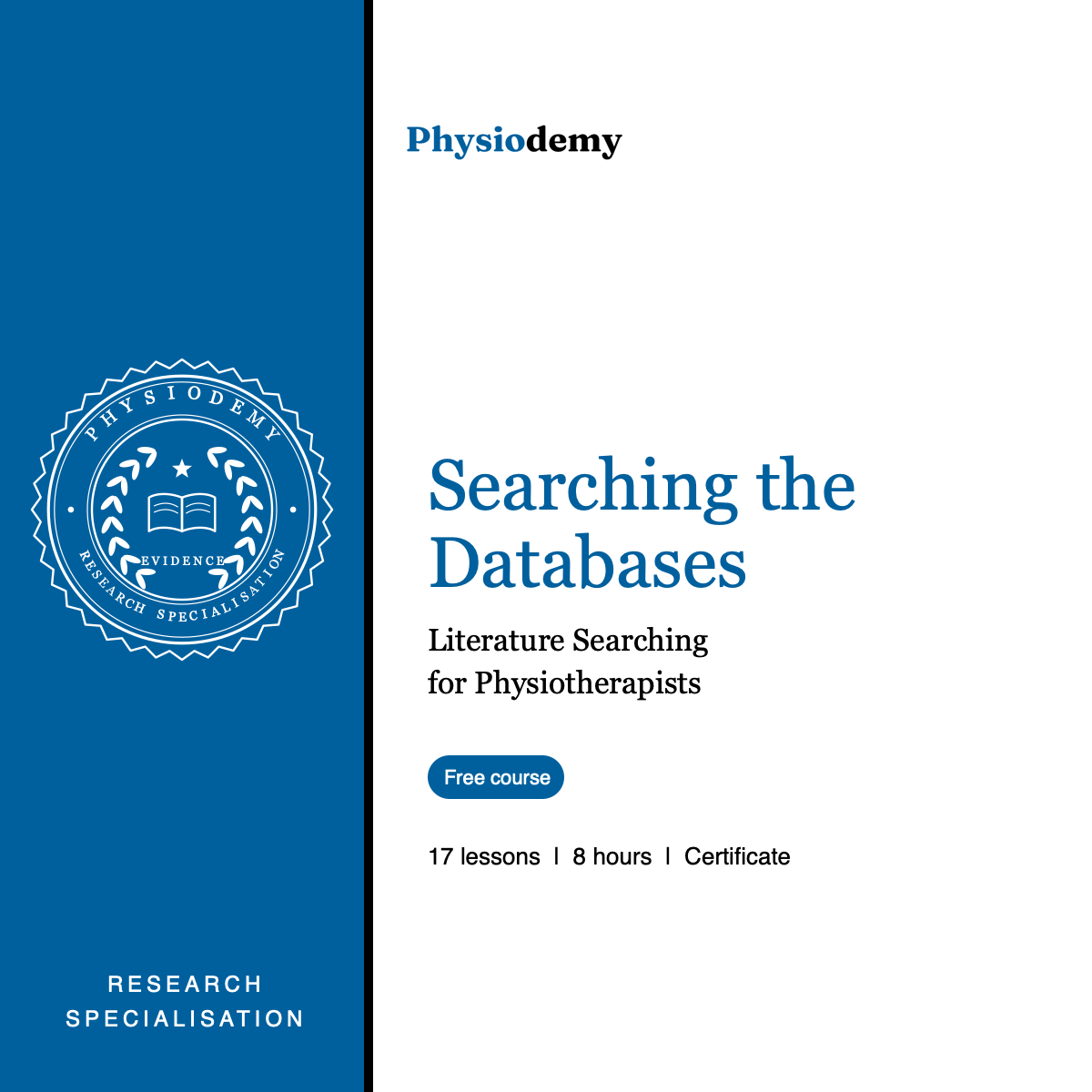
Learn to find research evidence properly. This course takes you from a clinical question to a search that is complete, recorded and repeatable, across every major database a physiotherapist or sports and exercise medicine clinician is likely to use.
Who this is for
Physiotherapists, sports and exercise medicine clinicians, students and early researchers who need to find evidence for a clinical question, a service evaluation, a masters or doctoral project, or a systematic or scoping review.
You do not need any research training. Every term is explained the first time it appears.
What you will be able to do
- Explain why a search is a research method, and what sensitivity and precision mean.
- Turn a clinical question into two or three searchable concept blocks.
- Build free-text search lines using synonyms, truncation, wildcards, phrases, proximity and field tags.
- Find and use subject headings (MeSH, Emtree, CINAHL headings), including explode and focus.
- Combine lines correctly with OR and AND, and read hit counts to spot errors.
- Run a structured search in each major health and sports database, and in trial registers and grey literature sources.
- Translate one search across databases without losing its meaning.
- Choose filters and limits knowingly, and state what each one costs.
- Record a search so that another person could rerun it, and report it to PRISMA-S.
- Export, deduplicate and hand over results to a screening tool.
Your four levels
The course is built as four levels. Each one ends with a milestone, and each gives you a title to show what you can now do.
| Level | Lessons | What you master | Your title |
|---|---|---|---|
| 1. Foundations | 1 to 5 | Questions, concept blocks, free text, subject headings, OR and AND | Question Builder |
| 2. The databases | 6 to 12 | A structured search in every major database, register and grey literature source | Database Navigator |
| 3. Putting it together | 13 to 17 | Translating, filtering, recording, reporting, managing results and fixing mistakes | Search Reporter |
| 4. Your own search | Final project | A full search on your own research question | Evidence Searcher |

Three things to earn
- Progress bar. It fills as you complete each lesson and quiz, so you always know how far you have come.
- Certificate of completion. Pass every quiz at 70 per cent or above and submit the final project.
- Evidence Searcher badge. Finish the course with an overall score of 90 per cent or above. You can retake any quiz to raise your score.
How each lesson works
| Part | What you do |
|---|---|
| Read and watch | A written guide with worked examples, plus one to three short videos. |
| Do | One practical task in a real database. Most tasks use free databases. Where a task needs a subscription database, a free alternative is given. |
| Check | A short quiz, marked straight away, with an explanation for every question. |
| Keep | Templates to download: a concept block planner, a search log and a cross-database syntax table. |
The lessons
| Lesson | Topic | Level | Time |
|---|---|---|---|
| 1 | Why searching is a method | Level 1 | 20 min |
| 2 | From question to concept blocks | Level 1 | 25 min |
| 3 | Free text | Level 1 | 25 min |
| 4 | Subject headings | Level 1 | 25 min |
| 5 | Boolean structure | Level 1 | 25 min |
| 6 | MEDLINE via PubMed | Level 2 | 25 min |
| 7 | MEDLINE via Ovid | Level 2 | 25 min |
| 8 | Embase | Level 2 | 20 min |
| 9 | CINAHL and SPORTDiscus on EBSCOhost | Level 2 | 30 min |
| 10 | PEDro and the Cochrane Library | Level 2 | 30 min |
| 11 | Web of Science, Scopus and Google Scholar | Level 2 | 25 min |
| 12 | Trial registers, grey literature and citation searching | Level 2 | 30 min |
| 13 | Translating one search across databases | Level 3 | 25 min |
| 14 | Filters and limits | Level 3 | 20 min |
| 15 | Recording and reporting the search | Level 3 | 25 min |
| 16 | Managing results | Level 3 | 25 min |
| 17 | Common mistakes and how to fix them | Level 3 | 25 min |
| 18 | Final project. Your own search, start to finish | Level 4 | 60 min |
How grading works
Each lesson ends with a short quiz. You need 70 per cent to pass a quiz, and you can retake it. After each attempt you will see which answers were right, with a short explanation for every question.
Your scores are saved in your Physiodemy account. You can see each quiz score and your overall course percentage at any time.
The course ends with a final project. You write your own research question, then build, run and record a full search for it. When you submit it, you will see a fully worked example and a checklist so you can judge your own work.
If your institution has its own rules
This is an online, self-directed course. If you study or work somewhere that has its own rules for searching, referencing or reporting, follow those rules wherever they differ from this course.
Transcript of the introduction video
Searching the Databases. A free course from Physiodemy, for physiotherapists and sports and exercise medicine clinicians.
We asked PubMed one question, two ways. Three words typed in found one hundred and nine records. A structured search found one thousand, three hundred and ninety six. The difference is evidence you would never have seen.
This course shows you how. You will turn a clinical question into concept blocks, combine ordinary words with subject headings, join them correctly, and record every line, so that anyone can repeat your search.
You will search every major database in the field. PubMed and Ovid. Embase, CINAHL and SPORTDiscus. PEDro and the Cochrane Library. Web of Science, Scopus and Google Scholar. And trial registers and grey literature.
Each lesson has four parts. Read and watch. Do one task in a real database. Check yourself with a short quiz. And keep the templates. There are seventeen lessons, about eight hours in total, and you do not need any research training.
You finish with a project of your own. Write your research question. Build, run, record and report the search. Compare it with a fully worked example. And earn your certificate of completion.
Start with lesson one. Why searching is a method.
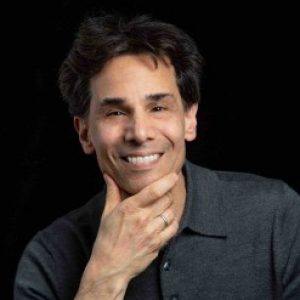
Course author: Karthik Muthumayandi. Part of: the Physiodemy Research Specialisation.